
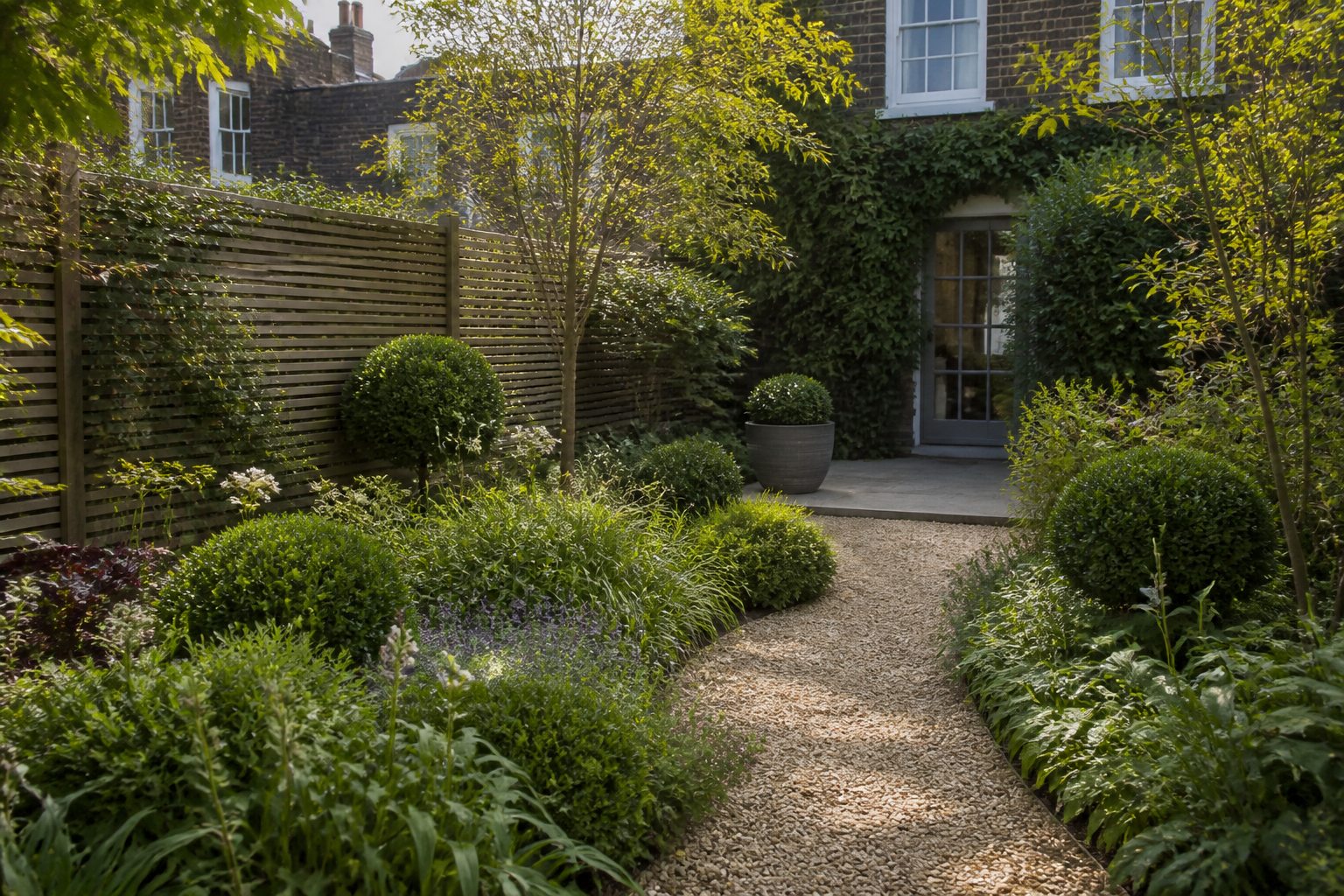
Low maintenance does not mean no maintenance. It means choosing a layout and planting palette that stay presentable with predictable, manageable work throughout the year.
The most successful easy-care gardens are designed around the actual site: its light, soil, drainage, access and the amount of time available. A fashionable plant placed in the wrong conditions creates more work, not less. For London homes, the biggest gains often come from simplifying edges, improving soil before planting and giving every plant enough room to reach its natural size.
Measure the conditions, not just the dimensions
Record where sun reaches in spring and summer, which corners remain damp after rain and where neighbouring buildings create shade. A south-facing wall can be hot and dry while the opposite boundary stays cool. Treating the garden as one uniform space leads to avoidable watering and plant replacement.
Check soil texture in several places. London gardens may contain compacted subsoil, building debris or imported topsoil within a few metres. Improve structure with organic matter where appropriate, but do not assume every drainage problem can be solved by adding compost. Persistent standing water may require level changes or professional drainage advice.
Simplify the shapes that need regular attention
Intricate lawn edges, narrow strips of turf and tiny isolated beds create repeated trimming. Broad curves or straight, accessible edges are faster to maintain. If a shaded lawn never performs, a planted bed, permeable gravel area or suitable ground cover may be more practical.
Keep paths wide enough for normal use and avoid materials that trap constant leaf litter in awkward joints. Good access matters: a beautiful bed that cannot be reached without stepping on plants will become difficult to weed and prune.
Practical tip: Before changing the whole garden, remove one recurring maintenance problem. A single awkward lawn strip or congested corner can consume a disproportionate amount of time.
Choose plants by mature size and behaviour
Read the expected height and spread, then allow for the sheltered conditions common in urban gardens. A shrub planted too close to a path will need constant cutting and may never develop an attractive form. Fewer, well-spaced plants usually look calmer and are easier to care for than many small impulse purchases.
Reliable evergreen structure can reduce the sense of winter emptiness, but an all-evergreen scheme may become visually heavy. Combine a limited number of structural shrubs with perennials and bulbs that suit the same conditions. Repetition creates cohesion and simplifies care because similar plants can be maintained together.
- Use drought-tolerant plants only where drainage and light genuinely suit them.
- Avoid vigorous climbers on weak fences or inaccessible walls.
- Choose disease-resistant varieties when roses or fruit are important.
- Limit containers to sizes that can hold moisture between watering visits.
Use mulch as part of the system
A suitable organic mulch suppresses many annual weeds, reduces moisture loss and improves the soil as it breaks down. Apply it to moist, weed-free soil and keep it away from direct contact with woody stems. A thin decorative dusting will not provide the same benefit as a practical layer.
Membranes beneath organic mulch often become mixed with soil and weed roots over time, making later changes difficult. They may have a role beneath some gravel areas, but they are not a substitute for preparing perennial weeds properly before planting.
Design containers to survive normal life
Small pots dry rapidly in summer and can become waterlogged in winter. Use fewer, larger frost-resistant containers with clear drainage holes and raise them slightly so water can escape. Group plants with similar needs rather than mixing thirsty and drought-tolerant species in one pot.
Automatic irrigation can help during holidays, but it must be tested and adjusted through the season. A timer set in April may overwater after wet weather or become insufficient during a hot July. Check emitters for blockages and make sure runoff cannot damage neighbouring property.
Build maintenance into four seasonal visits
Even an easy-care garden benefits from planned attention. In late winter, inspect structure and complete appropriate pruning. Spring is for mulching, supports and early weed control. Summer work focuses on watering, lawn care and keeping vigorous growth clear of paths. Autumn is the time to manage leaves, divide selected perennials and prepare vulnerable containers.
Short, regular checks prevent large corrective jobs. Ten minutes spent removing a self-seeded tree or tying in a climber can save hours later. Keep a simple note of what was pruned and when, especially in a shared or rented garden.
Know where low maintenance becomes false economy
Artificial shortcuts can create future work. Impermeable surfaces may worsen runoff, cheap fencing may fail under mature climbers and fast-growing screening plants can require several cuts each year. Judge materials and plants by their whole-life care, not only the installation price.
A garden that matches the household will always be easier to maintain. Leave room for bins, bicycles, play and outdoor seating rather than designing every metre as display planting. Practical space used well looks better than an ambitious layout that cannot be sustained.
Choose hedges that fit the available maintenance time
Fast-growing conifers can provide screening quickly but may require several cuts each year and often respond poorly if cut back beyond green growth. Mixed native hedges offer wildlife value but need space and a different visual expectation. Slower evergreen shrubs may suit a formal compact boundary when their mature width is allowed.
Before planting, agree access to both sides and the final height. A hedge squeezed against a path or neighbouring fence creates difficult cutting and waste handling. Screening should solve a privacy need without becoming the dominant maintenance task.
Use irrigation without creating dependency
A drip system can reduce daily labour for containers and new beds, but only when emitters match plant needs and the system is checked. Hidden leaks waste water, blocked outlets leave individual plants dry and an unchanged timer can overwater during rainy periods.
Zone sunny containers separately from shaded beds. Inspect soil manually, adjust through the season and shut down vulnerable components before frost. Once established, review whether all plants still need automatic watering.
Practical tip: An irrigation controller is a schedule, not a moisture sensor unless specifically equipped and configured as one.
Plan low-maintenance interest for winter
Evergreen structure, bark, seed heads and grasses can keep a garden composed after flowers fade. Choose features that remain attractive in the actual site conditions; some grasses collapse in wet shade and some evergreens scorch in exposed containers.
Place the strongest winter view where it can be seen from the house. A small group of well-shaped plants has more impact than filling every bed. Leave suitable stems for wildlife, then cut them back before new growth where the species requires it.
Avoid common low-maintenance shortcuts
Covering poor soil with membrane and a thin layer of gravel does not remove perennial weeds or correct drainage. Replacing every bed with paving increases runoff and cleaning. Filling the garden with one supposedly indestructible plant creates visual monotony and vulnerability to a single pest or disease.
The better shortcut is thoughtful reduction: fewer edges, fewer tiny containers, fewer unsuitable plants and clear access to everything that remains. Preparation takes time once, then lowers the recurring workload.
- Do not plant before solving persistent drainage.
- Do not choose screening without checking growth rate.
- Do not make surfaces impermeable by default.
- Do not underestimate establishment watering.
Related gardening guides
- Easy-care garden ideas for busy homeowners
- Small garden ideas that make better use of space
- A seasonal guide to maintaining your garden
Need a hand with the practical work?
If you want to reduce recurring work, our garden maintenance and landscaping teams can help assess the existing layout and prioritise practical improvements.